For the executive who owns the outcome, not the tool.
Chief executives, senior leadership teams, and the HR and operations leaders who sponsor the work — in organizations that are setting AI strategy for the first time or restarting one that stalled.
Most organizations you will talk to have not adopted AI yet. The copy assumes strategy-setting, not rescue.
● The strategy names tools and timelines but not the behavior change it depends on.
● Nobody owns adoption after the pilot. The sponsor moves on; the team goes back to the old way.
● Governance arrives after the first incident instead of before it.
● Return is measured on a quarterly clock against a two-year curve, and the program is cancelled just before the evidence would have appeared.
Capacity gets added. Capability never does — so the next change starts from zero again.

Prepare — put the ground under it
Before anything is built: where the organization actually stands, what the strategy has to answer, and who is accountable for what.
● AI transformation readiness diagnostic across leadership, culture, data, process and governance
● AI strategy and governance design — use cases, guardrails, decision rights, and the ethical commitments leaders will be held to
● Senior leadership alignment on what is changing and what will not
● An ROI expectation agreement: what evidence is expected, when, and how it will be judged
The System in Detail
Plant — put it into the work
Where most programs stop at the pilot, this stage treats the team as the unit of change.
● Team culture intervention, including SDI 2.0® facilitation, so teams can name how they work, where trust breaks, and what pressure does to them
● First-win selection and pilot design — one use case chosen for evidence, not for ambition
● Leader coaching for the executives carrying the change
Team coaching on a retainer, through the stretch where new ways of working either stick or quietly stop
Prosper — make it grow
The stage that separates a successful pilot from a changed organization.
● Dynamic work design — rebuilding workflows around where human judgment belongs and where machine speed does
● Human–AI working agreements the team writes and agrees to hold
● Capability building, so the next use case does not need an outside consultant
● Sustainment coaching and measurement against the evidence curve

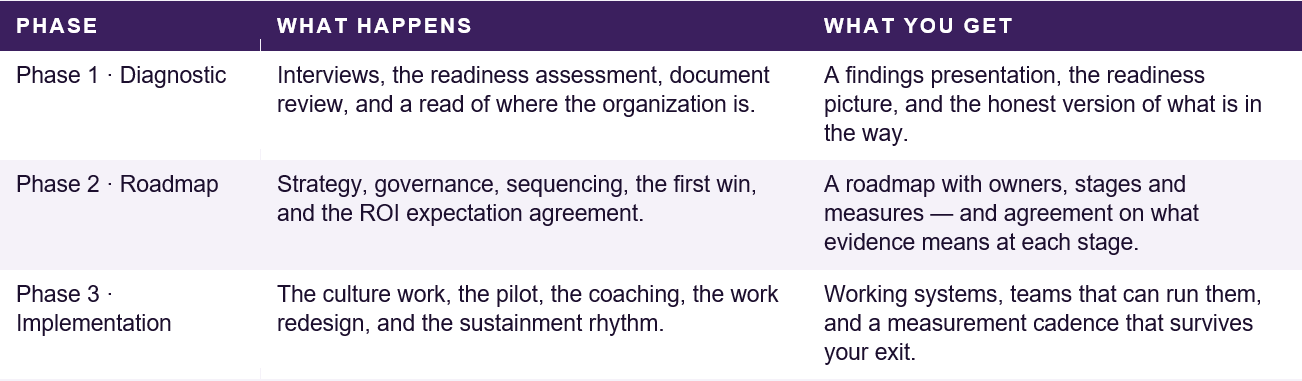
How an engagement runs
Three phases on a horizontal timeline. Each phase names what you deliver, so a buyer can see the shape of a contract.
Coaching Inside the System
The coaching is not an add-on. It is how the change survives contact with Monday.
Leader and team coaching runs inside Plant and Prosper, on a retainer, for the executives and teams carrying the work. It is the same developmental coaching practiced at The Grounded Luminary, delivered here as part of the engagement.
Organizations that want coaching cohorts on their own — without an AI transformation around them — are served directly by the coaching practice.
Engagements are scoped to the organization — its size, how many teams are in scope, and how far along the strategy already is. We settle that in the briefing, not before.
Sixty minutes with your senior team on what AI adoption asks of an organization beyond the technology — what the four preconditions are, what the evidence timeline really looks like, and where your organization sits. No proposal attached.